

A favourite genre of mine has always been CRPGs. I think the first ones I played back in the Commodore 64 days were Telengard or maybe Temple of Apshai, but the first one I really remember got sucked into was Phantasie. If I remember correctly, Telegard didn't really have a goal. You just explored the dungeon and tried to level up, stay alive, and keep going. But Phantasie had a modicum of a story or at least a goal to work toward. You created a party of little guys and took them out on adventures and tried to find loot and level them up while working your way across the land to eventually fight the Big Villain, albeit at whatever pace you wanted. I've always worried about the career paths for my RPG characters than I ever have for my own career 😅
The two CRPGs I "invested" the most time into were Ultima IV and Bard's Tale 1. I wrote a bit about Ultima IV and some of its influence on Delve before. Let's talk about Bard's Tale.
Bard's Tale 1
Bard's Tale was a dungeon crawler — a blobber, I hear the kids call them now, because your party moves around the dungeon as a blob — and its graphics on the C64 were amazing! It's frankly magic what they fit on two 170Kb floppy discs.
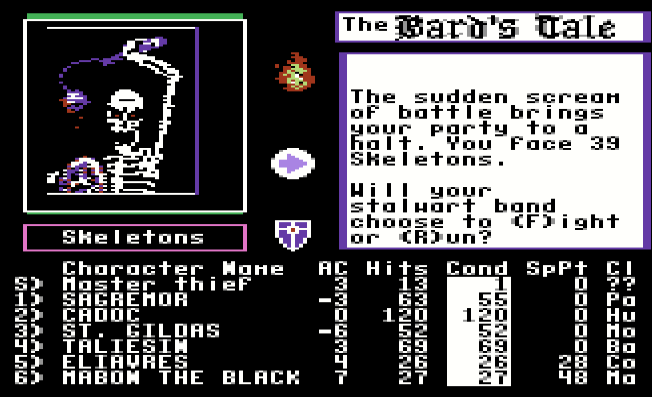
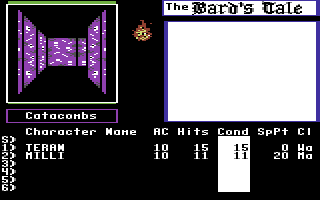
Impressive stuff for 1986
Bard's Tale 1 was pretty obviously an attempt to improve on Wizardry. Better visuals, improved UI, but the same general faux-3D first person style and concept. You made your characters and started exploring for gold and XP. There's less story than Ultima IV or even Phantasie. The town of Skara Brae has been cursed by an evil wizard whose minions are running rampant and you need to become strong enough to eventually defeat him. That's it! Go forth, brave adventurers!!
One technical limitation of these early games on those old 8-bit home computers was a lack of auto-mapping. You had to draw your own maps on graph paper. I say technical limitation, but this is a feature of those games that I really enjoyed. You were effectively tracking progress on your current dungeon level by filling it out as you explored and after you were done the game you had a physical artifact of the time you spent.
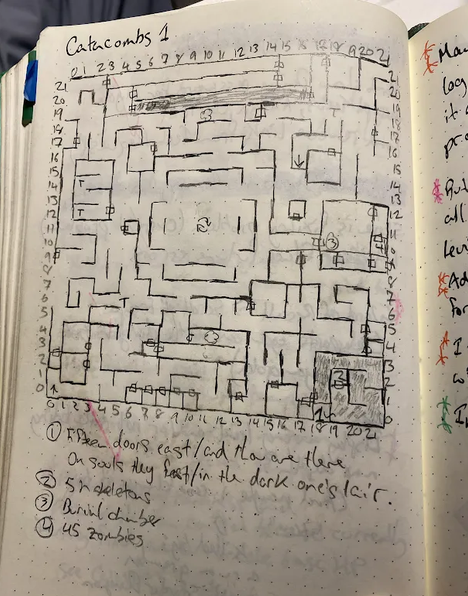
Yes this part of the fun for me
I would spend hours slowly exploring and mapping the dungeons, developing my characters. Working toward the end of the game but in no real hurry to get there.
But what if I made a knockoff?
I still happily play Bard's Tale from time-to-time and I probably have the first couple levels of the first two dungeons memorized. But...what if Bard's Tale had randomized maps so when you started a new game you had new levels to explore? This is an idea that has a lot of appeal to me! I've thought about this concept off and on for a long time, but I am not a graphics guy. I have other projects to work on. Plus, I can always just play Bard's Tale. There was a quite a nice remaster of the original trilogy that's often on sale.
I recently happened across some art assets for a retro-styled blobber available under a CC0 license, made by Clint Bellanger for Heroine Dusk and suddenly the itch to make my own BT-esque dungeon crawler got very itchy.
Bard's Tale has relatively simple systems and I don't think will be too difficult to build. The hardest part for me is the faux-3D first person display. The original game didn't really do 3D. Instead, it draws pre-fab cutouts for the walls/doors/etc. The game had pieces for each wall texture and various distances and that's how Clint Bellanger's assets work. If I got that working, all the rest of the game systems would be fairly easy. It's just pretty simply D&D math!
So, I started a new project (called BardsTaleKnockoff) and set about. I have to admit, I'm not a graphics guy and I leaned on Claude for help with the finicky math of where to draw the pieces and pretty soon I had a simple working version of a Bard's Tile-like display using SDL! One limitation at the moment is that I can only display to a distance 1, 2, or 3 tiles. For more, I'll need to either edit the art assets or learn how to scale my existing assets to be smaller. For either one I anticipate a bunch of annoying debugging...
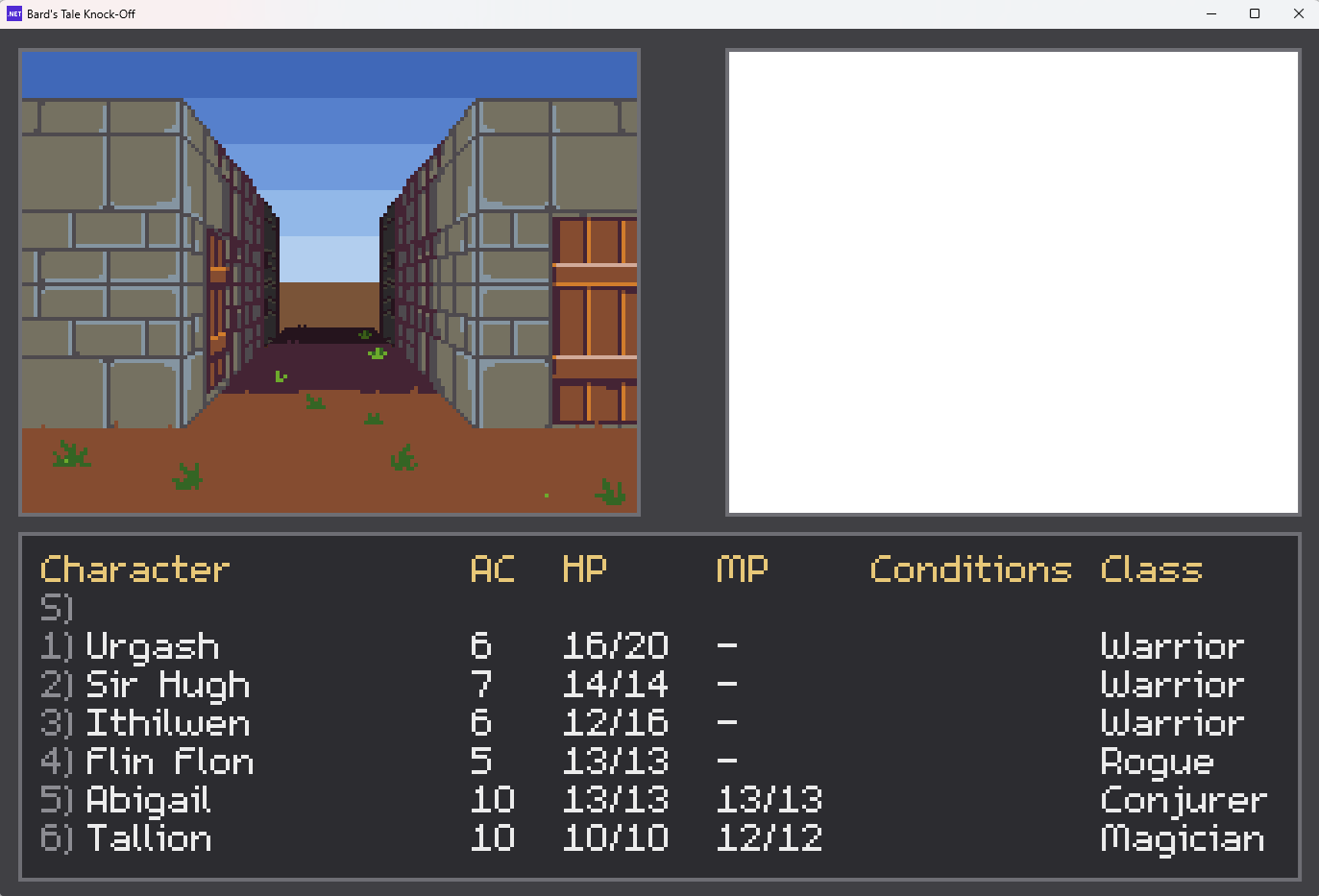
We very quickly had a display
Project Scope
But what am I really trying to do here, since Bard's Tale 1 already exists? I certainly don't want to just clone the game. It already exists and I can play it right now!
Let me dig into my favourite aspects of Bard's Tale. First, as mentioned, there's the mapping. If I can come up with a decent level generator, I can explore new levels and draw them in my notebooks to my heart's content! The thing about procedural generation is that the maps created won't — can't — be as good as carefully crafted levels designed by a human. But BT's maps were generally mostly maze like and had only very minor puzzles. They mostly existed for you to map out while you were grinding to level your characters up. I have so ideas for some features and puzzles I might be able to work into the game.
My dungeon crawler won't have an automap feature.
Bard's Tale had 5 dungeons for a total of 16 levels. For my game, I'll probably do just one dungeon of 12 levels. It should take less time to finish than the original Bard's Tale.
My favourite stage of the original was the hard-scrabble early game. Your characters start off weak and everything is dangerous. You don't even have access to healing spells right away. Bard's Tale's manual even suggested you don't worry about low-level characters who perish. Just take their stuff and make a new character. I took to numbering my characters as I replaced them. In my last run, my fighter was Urgash 5 before my character stopped dying (or rather, I began being able to bring them back to life). The fun here is the tension and stress. Every time you left the Adventurer's Guild, there was tension and stress. Am I going to plunder into a fight that's just too difficult for my crew and people will die before I can flee. Even a reasonable battle that goes poorly can be a disaster early on you need to spend money to heal your people. While also trying to save up money for better gear and the costs of levelling them up and buying access to the new spells for your mages. In those early games, it was often the case that you could only save the game in a tavern (or in BT's case the Adventurer's Guild). Again, probably this arises from technical limitations, but that also adds stakes to the game. Sometimes you set out to explore level 2 of the Catacombs, have some bad luck and have to retreat and heal up. No easy reloading from a convenient save slot. In fact, no saving before at all you try something risky.
In fact, I'd like to keep those high stakes and maybe extend them. I'm pondering not allowing you to bring back to life characters of 5th level or below and there being a small chance of resurrection failing, leaving the character permanently dead. On the other hand, BT tended to be very punishing. Especially in the later dungeons, you'd have fights that would easily wipe your party no matter how powerful you'd become. Surviving the end game was a matter of luck, knowing what to run from, and/or spending tens of thousands of gold after a TPK. I'd like to try to find a better balance where having your party completely wiped out is much less common. I'm thinking of adding a spell that will let you flee from battle as well?
In Bard's Tale, if your party is wiped you can't reload from a save slot, but you'd be returned to the Guild. You'd then have to do the walk of shame and make a character to haul your main party's bodies to a temple to bring them back to life. For my knockoff, though, I'm thinking instead that when your party is wiped out, that's it. They are dead. However, their remains will start in the dungeon and future parties can find their remains, at which point you can loot their corpses or bring them out to be resurrected. I think Wizardy 1 did this?
BT's characters hewed pretty close to D&D, you had classes for fighters, mages, rogues. And, of course, a bard who played music that provided buffs. Having a bard was also required for a couple of the game's puzzles. I'm not sure if I'm going to keep the bard around in my game. BT also did something neat with magic-users. There were four different spellcaster classes: conjurer, magician, sorcerer, and wizard. New characters can only be created as a conjuror or magician. To become a sorcerer or wizard, you'd have to reach level 5 as a conjuror or magician and then switch classes to become a sorcerer or wizard. However you cannot return to a class after you change so you'd generally want to stay as a class until you've learned all its spells and ideally you'll eventually build up at least 1 (ideally more) archmage: a spellcaster who has learned all the spells of all the classes. I like this stuff and I'm going to keep. I might tweak the spell list here and there.
I'm changing up the class system a bit and borrowing the idea of prestige/specialty classes. In my game, after gaining some experience rogues and warriors will have the option switch to a different class. I have ideas for paladins and archers for warriors and assassins and tricksters for rogues. Each specialization with get some special abilities but a paladin won't be quite as good at fighting as, say, a pure warrior will be.
One aspect of BT that is arguably poor design is that the non-magic-users are very weak. Early in the game, the warriors exist to keep the spellcasters alive and in the later game they don't really accomplish much and the casters kill most of the bad guys. The fighters become just bags of HP that exist to keep monsters from biting the spellcasters who are in the back ranks of your party. I plan to give the other classes more abilities to make them useful in combat and maybe dial back the dominance of the casters. Perhaps they'll have more effective buff-type spells? One idea so far is that warriors will be able to cleave. If they deal more damage than it takes to kill an orc that damage will carry through to other monsters in a group. We'll see what else I can come up with, but I want to have the other classes be more than just meat shields.
In summary: what I am looking to build is Bard's Tale that's a somewhat shorter than the original, that extends its tense early game, and hopefully better balances the later game and the non-magic-user classes. Replayability is a goal but then again I also happily replay the original Bard's Tale so maybe that is less important.
What of Delve?
Oh, I've not abandoned Delve! But this game will be a pretty short term project, I think. I hope. I am cribbing off an existing design and there is just way less stuff to implement. No line-of-sight. No pathfinding. Trivial monster AI. My rough guess is that I'll be finished Knockoff (I need a proper name for it...) in under a month. We coders are pretty terrible at estimating how long things will take but a bunch feels pretty achievable. I have basic combat and the display pretty much working and working and that's really the bulk of Bard's Tale! Most of the rest is just content.
Here's a video of a very early build:
I'm writing it in C#, using SDL3 for the display.
So, Bard's Tale Knockoff is a just a little side-side-project. I'll keep poking at Delve and get back to it fully once this is done. Delve is a long term project, whereas this game is just a game I want to exist right now so I can play it!
I really need to come up with a name for it that isn't Bard's Tale Knockoff...
I fully expect that the target demographic for this is exactly: me. That said, its source code is available on GitHub under a Creative Commons 0 1.0 Universal license. When it's all done (or at least at version 1.0), I'll probably also make binaries available on itch.io, but that will have to wait until I've assembled open source or Creative Commons art for everything in the game.
